Interesting piece from Wired magazine on how the U.S. government is using serious gaming in training it's intelligence staff in critical decision making:
'In the wake of the intelligence bungles that propelled the United States into the Iraq war, it's no secret that the nation's spies have been working to improve the quality of their analysis. Now the top U.S. military intelligence agency has come up with a new tool for teaching recruits critical thinking skills: videogames.
The U.S. Defense Intelligence Agency has just taken delivery of three PC-based games, developed by simulation studio Visual Purple under a $2.6 million contract between the DIA and defense contractor Concurrent Technologies. The goal is to quickly train the next generation of spies to analyze complex issues like Islamic fundamentalism. '
Note: this entry was originally submitted to the MsC in E-learning 'Game Design' Module in November 2007 to Hamish MacCleod (tutor) as a mid-term paper.
This review will examine the game 'Battlefield 2' with a view towards an educational adaptation for Police training - an adaptation which seeks to create what J. P. Gee calls 'distributed authentic professionalism'.
BF2's strengths lie in its collaborative real-time gaming. Players enter one of twelve maps, choose a 32-member team to play on (usually USA or Middle Eastern Coalition- MEC), join a six-member squad and pick one of six standard 'classes'. These classes are: Special Forces, Assault, Sniper, Engineer, Medic and Anti-tank. Players can also create custom squads, invite other players to that squad, and act as a conduit for communications between squad members and the commander.
Depending on the rank you have achieved, with promotions and weapon-unlocks given based on your performance, you can apply to be commander of the whole team. It's these last two functionalities of command and communication, in addition to the novel usage of vehicles for collaborative transport and combat, that lend themselves most readily to an educational adaptation of BF2.
A brief look at the functional options for squad members, squad leaders and commanders respectively, allows us to discuss potential adaptation to a Policing scenario.Taking a quick look at some standard BF2 gameplay might help visualise some of these ideas. You can do so by watching this video. (Please note that the banging techno was not my choice).
Player classes have a range of weapons and kit - easily accessed either by using the keyboard's 1-5 buttons or the scroll-wheel on the mouse. The basic 'Assault class' soldier, for example, has a knife (1), side-arm (2), machine-gun (3), and grenade launcher (4). The medic or engineer has further options with a medical kit (5) and shock paddles (6) or, in the case of the engineer, a wrench to fix damaged vehicles and artillery guns or radar stations. These could be replaced with the four or five pieces of standard kit which a Police Officer carries - notebook, handcuffs, torch, Airwaves radio set etc. Each one could be activated in the same way as a weapon or piece of kit in BF2.
Such selection could enable simulations of arrest scenarios, interview and statement taking procedures, surveillance operations and radio communications -using VoIP which the BF2 engine exploits wonderfully. Since Police Officers are required to report their movements and to be accountable for their actions (constantly carrying out dynamic risk assessments), VoIP communication provides a rich means to practice communication protocols.
Additionally, as noted by Manninen and Kujappaa, the Battlefield game allows for additional 'perceivable and holistic manifestations of interaction that enable players to fully collaborate and cooperate in networked game settings'.
So, what would a policing-based adaptation of the BF2 engine look and feel like? The game would begin with a clear statement about the value systems of the game, encouraging gamers to behave, think and communicate like a Police Officer. It would offer a fish-tank and sand-box; emphasise the impact of decisions; allow for customisation of kit; elaborate on your role; provide well-ordered problems; be pleasantly frustrating; give cycles of expertise which challenge gamers' evolving skills, within the regime of the gamers' competence; give just-in-time information; and ties sets of skills together into larger contexts of activity. All done within legislative and procedural guidance.
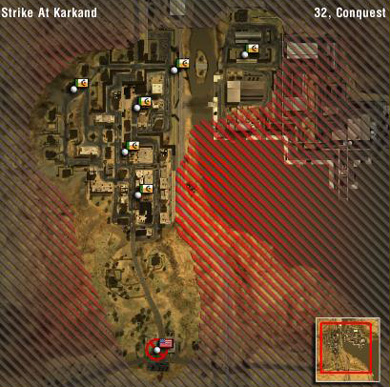
The 'downtown Baghdad' location (perhaps based on the 'Strike at Karkand' map) is replaced with a 'downtown Newcastle' setting and the simulation replicates a busy Saturday night. The map could have three or four pubs, nightspots, take-away food locations (known flash-points for public disorder) and transport systems, such as bus depots and taxi-ranks, which need to be vigilantly policed.
A commander can receive real-time intelligence from his IBO centre (Integrated Borough Operations) on incidents that are breaking out. A challenging, but realistic, game might involve a commander receiving intelligence on two or three incidents of public disorder, a traffic collision, a domestic violence incident, a stolen vehicle, perhaps involved in joy-riding, or a missing persons report.
The commander then dispatches vehicles containing squads of six to each location, with specific orders. At the scene, the squad leaders are required to communicate with the commander - reporting on the scene, requesting resources and back-up - with individual officers expected to interact with avatars at the scene. The avatars themselves (which could be programmed bots, or better still real players acting as inebriates, violent spouses or whatever) allow for real-time, on the scene policing simulations with officers making dynamic decisions - reported via VoIP.
In BF2, squad members access a series of communication short-cuts by pressing the Q key and using the mouse to choose from a menu. Standard requests include 'Need ammo', 'Need medic' and 'Need backup'. In addition, a central menu interface gives an 'Enemy spotted' option which, with a right-click, allows you to specify the threat e.g. 'Enemy tank spotted'. These could be adapted to code-specific Police communications and the 'enemy spotted' option changed to communicate specific incidents such as 'traffic collision', 'domestic violence incident' etc.
Squad leaders gain access to a higher level of functionality in the game's standard map (accessed by pressing the M key) where they are able to request a range of services from the commander. Specifically they can request artillery strikes, vehicle drops, supply drops, reinforcements and unmanned aerial vehicles to act as radar for spotting mobile enemy. The adaptations for a policing scenario are obvious enough: the UAV request easily translates to a request for helicopter assistance, the back-up request to a ambulance or medical services support, and the requests for artillery and supplies to intelligence requests such as a standard Police National Computer (PNC) check.
Commanders receive access to a third level of functionality (from the Caps Lock key) which enables them to meet the requests of squad leaders e.g. 'artillery strike on this location'. Crucially, commanders have the ability to issue specific orders at specific locations on the map. There is the standard 'attack/defend this position' order, but you can also order demolition or repairs at a location. This ability allows a commander to tackle multiple tasks at the same time. This readily maps to the range of choices which a BCU (Basic Command Unit) Commander faces when dealing with a busy Saturday night in a town or village.
BF2 has an array of vehicle options including quad bikes, hummers, tanks, APVs, fighter jets, helicopters and boats. Their value lies in the gamers' ability to enter vehicles with team mates. Each vehicle allows up to eight players to driven to a location. Given that the commander can issue location and situation specific orders, e.g. 'place demolitions at this co-ordinate', a Policing simulation could enable commanders to order mobile response units to proceed to a location and deal with an incident there. In-vehicle time could be used to send field-briefings to officers as well as for officers to speak to and learn from each other.
Given the continued threat of terrorism, and the need for robust police training in dealing with that threat, a similar design solution could simulate management of assets and resources during a terrorist incident, enabling differing ranks of players to learn counter-terrorist, critical incident and emergency procedures collaboratively.
This is an updated version of a blog post which I originally submitted as part of my MsC. in E-learning at the University of Edinburgh, in Spring 2007.
Unavoidable
Anyone who attends e-learning conferences (or keeps up with the chatter on the blogs) will have found it difficult to avoid references to 'digital natives'. There are other terms which are popular (like 'Gamers', or 'Gen Y') but the term 'digital native' is perhaps the most commonly used term to describe the people currently entering the workforce.
But what are they and where does the term come from?
The term was coined by the author Marc Prensky (pictured above) who used it to distinguish between people who have grown up using interactive multimedia and those who are having to 'learn' how to interact with and use services like Youtube, Google Reader and the dizzying array of social web services like Facebook, Orkut and Myspace.
'Today's students – K through college – represent the first generations to grow up with this new technology. They have spent their entire lives surrounded by and using computers, videogames, digital music players, video cams, cell phones, and all the other toys and tools of the digital age. Today's average college grads have spent less than 5,000 hours of their lives reading, but over 10,000 hours playing video games (not to mention 20,000 hours watching TV). Computer games, email, the Internet, cell phones and instant messaging are integral parts of their lives.
It is now clear that as a result of this ubiquitous environment and the sheer volume of their interaction with it, today's students think and process information fundamentally differently from their predecessors. These differences go far further and deeper than most educators suspect or realize. “Different kinds of experiences lead to different brain structures, “ says Dr. Bruce D. Perry of Baylor College of Medicine. As we shall see in the next installment, it is very likely that our students’ brains have physically changed – and are different from ours – as a result of how they grew up. But whether or not this is literally true, we can say with certainty that their thinking patterns have changed. I will get to how they have changed in a minute.'
Suspicions
My reading of Prensky's article on digital 'immigrants' and 'natives' was thought-provoking in two ways: firstly in that it seemed to confirm some long-held suspicions about current educational models and secondly because it proposed a new division of learners which I'm not entirely sure I'm comfortable with.
Prensky's arguments that 'digital natives' are not being well served by traditional pedagogies is one part of a larger argument which has been bubbling up within the zeitgeist for some time now. Any of us working in educational fields will be long-familiar with constant claims that school-children are more disengaged than ever before, with teachers complaining that learners are switched-off, suffering from attention-deficit disorder and that they lack the basic ability to concentrate in class. This isn't new - Plato uttered similar complaints in the 6th century BCE.
What's notable now is that such complaints have become so vociferous in recent years that increasingly there are more and more people suggesting that rather than there being issues with the learners, there is in fact a fundamental problem with the system which is trying to educate them.
Underground History
Some time back I stumbled across the work of John Taylor Gatto, who in his groundbreaking book 'The Underground History Of American Education' suggested that the American educational system is designed as nothing more than a complex factory line for producing hordes of compliant individuals, whose sole purpose in life is to willingly submit themselves to processing by multi-national corporations in menial physical labour.
The exact details of how this project came to be are complex, but if we accept Gatto's arguments for a moment, a large problem makes itself very clear. The Anglo-Prussian model upon which the US system was based was designed during a time of Industrial manufacturing. That age is now gone - with today's school-leavers thrust into a global 'knowledge economy' which they are ill-prepared to compete in.
This notion has been surfacing in several places - from blogs, to academic journals - to mainstream media where we saw in an episode from the seventh season of the TV show 'The West Wing', Democratic candidate Matt Santos (played by Jimmy Smits) railing against the US educational system because it was based on the agrarian calendar.
As dead as Gagne
I have no difficulty in accepting that some older pedagogical models may have had their day in the sun, but I'm concerned that such a rush to embrace the future may marginalise those of us who do not necessarily fit comfortably into one of Prensky's two categories. For example, Donald Clark (former CEO of the Epic e-learning company - where I worked for a year) posted a blog in February of 2007, where he stated that the increase in usage of the web in education is 'killing Gagne dead'. The Gagne that he refers to is Robert Gagne and his 'Nine events of learning'. This is probably the most often used ID model for producing 'chapters' of digital e-learning content.
Clark argues that the increased accessibility of content via the web (notably video content) is knocking such 'guided' models out of the water entirely. To an extent I agree with him - I believe that many digital learning solutions are designed not with the learner in mind but rather the tutor - accommodating perhaps the tutor's preferred learning styles rather than the learners.
However, a white paper from Epic (which Donald, as you can see from the comments below the blog post in question, is at pains to point out he did not write) makes a good case for different usage of ID models for different audiences. Specifically, it suggests that 'entry-level' audiences would benefit from the more guided models (of which Gagne is an excellent example) and that more free-form models of self-guided learning (such as are facilitated by the web) work better for more senior and experienced learners - who crucially have the time and the technical skills to enable such learning to occur.
Pedagogy or not?
My own experiences would seem to back this up: I work in creating digital learning solutions for a range of audiences - all of them in the Police services of the UK. Unbelievably, entry level learners to the police force have no protected learning time - rendering any offer for learners to learn in their 'own way' redundant. This, coupled with the fact that the learners we design for are acquiring sensitive, challenging and highly legislation-sensitive materials, behoves us to provide a clearer line of guidance in any learning materials provided. I would prefer it that we lived in a world that allowed trainee Police officers the opportunity to have exploratory, free-form learning experiences but the time constraints, legislation compliance and complexity of information negates this from happening - at least for entry level learners. Digital natives or not, pedagogy (of some form) is required for audiences such as this.
I can't help but feel that Prensky's narrow division of learners into 'natives' and 'immigrants' is reductive, binary and perhaps unhelpful. For certain a 12 year-old will have different wiring (as a result of the neuro-plasticity which Steven Johnson alludes to in his book 'Everything Bad Is Good For You') than a 32 year-old as myself, but I'm not entirely ignorant of new technologies and in some rare instances still have the ability to wow my teenage nephews with what seems to them like arcane knowledge of the web and it's myriad services. On the flip side, put them up against me in a PS2 shoot-em-up and they'll annihilate me. I'd like to think that myself and my nephew fit somewhere in-between 'native' and 'immigrant' and that neither of us would be pigeon-holed into one educational model based on our age and hours put in on an Xbox.
Shamelessly reworking Tim O'Reilly's concept of 'Perpetual Beta', this blog is a random space for personal musings on e-learning, technology, digital cartography and making a better education system for the 21st century. Failing that, I'll just post amusing Youtube clips.