Hmm. Edgy and important documentary making or scare-mongering nonsense? I'm not sure. I can't help but suspect that the makers of this show didn't do that much research into virtual spaces and their impact on relationships. To give just one example, the documentary states that SL has 4 million users - it doesn't. It has 4 million registered members - that's not the same as users. Anyway...
Part 1
Part 2
Part 3
Part 4
Monday, 30 June 2008


Tuesday, 24 June 2008
Map of the Weird
A few months back I was lucky enough to get to spend some time with Andrew Hudson-Smith from CASA who gave a fascinating talk on the application of web 2.0 tools to mapping and cartography. His blog 'Digital Urban' is well worth checking out.
Anyway, a few hours in Andrew's company was inspiring and set me off playing with Google Maps. Which led to the creation of a'Map of the Weird' for blather.net, the Irish site I write for in my spare time. Then I figured out how to export that into Google Earth. And then how to play it as a tour. And then, I thought to myself, why don't I just... well, you can watch the rest. Press play
Like I explained above, this is a first attempt at seeing what you can do using just Google Earth, an iPod and a screen capture software kit. Now to find an educational application...
Anyway, a few hours in Andrew's company was inspiring and set me off playing with Google Maps. Which led to the creation of a'Map of the Weird' for blather.net, the Irish site I write for in my spare time. Then I figured out how to export that into Google Earth. And then how to play it as a tour. And then, I thought to myself, why don't I just... well, you can watch the rest. Press play
Like I explained above, this is a first attempt at seeing what you can do using just Google Earth, an iPod and a screen capture software kit. Now to find an educational application...
Wednesday, 18 June 2008
Games, Learning Objectives and 'Telescoping'

If you should find yourself doing a course on game design, it's likely that you'll be asked to read James Paul Gee's book What Video Games Have to Teach Us About Learning and Literacy (2003). It's a brilliant book, but, perhaps not that easy a way into the subject.
But, for a good introduction to some of the themes involved in applying computer games to learning you could do no worse than to take a look at the Steven Johnson book 'Everything Bad Is Good For You' . It's possible that Johnson does an even better job of explaining Gee's theories than perhaps Gee does himself. However, in addition to nicely summarising Gee, he also draws your attention to an aspect of modern video games which has immediately obvious educational applications - what Johnson calls 'Telescoping'.
This is when a gamer is forced to hold multiple objectives in his or her head in order to achieve a final objective. I immediately thought of 'Terminal' and 'Enabling' learning objectives, which are a staple of the Instructional Design Framework which NCALT e-learning staff work to. What's crucial here is the manner in which these objectives are 'nested' inside one and other, encouraging gamers and learners to cultivate the mental skills required to keep short-term goals in sight whilst never losing sight of 'the bigger picture'.
From 'Everything Bad Is Good For You':
"I call the mental labour of managing all these simoultaneous objectives 'telescoping' because of the way that the objectives nest inside each other like a collapsed telescope. I like the term aswell because part of this skill lies in focusing on immediate problems whilsy maintaining a long-distance view. You can't progress far in a game if you simply deal with the puzzles you stumble across: you have to co-ordinate them with the ultimte objectives on the horizon. Talented gamers have mastered the ability to kep all these varied objectives alive in their head."
Grim Fandango
As part of the game design course I recently took, I asked to do a study of the classic Lucas Arts game 'Grim Fandango' (pictured above) recently which gave me some classic examples.
Designed in 1998 by Lucasarts and widely held as the best 'adventure game' of all time, Fandango was a critical success but commercial flop. It still carries a large, cult following and has be held up as an exemplar of the genre of games.
Set in a universe inspired by Mexican day of the Dead mythology, the game is a tricky adventure game with a plot every bit as intricate as a Philip Marlowe novel. The clever story is complimented by an Art Deco look and feel, bonkers Bandito/Bee-Bop/Jazz score and excellent voice talent. Oh and it's very funny.
The game was the brainchild of Tim Schafer, previously responsible for the celebrated Monkey Island and Full Throttle. From Wikipedia:
'The story unfolds in four episodes, each set a year apart on the Day of the Dead. It is from this festival that much of the game's imagery is drawn — most of the game's characters look like skeletal calaca figures (based on the work of Mexican printmaker José Guadalupe Posada). Various flowers are also used as tools of murder, in the form of a substance known as "Sproutella", which reacts with bone, destroying it by causing flowers to grow in it extremely rapidly. Characters refer to this manner of death as "sprouting". There is also unique fauna scattered throughout the game, such as bone-eating fire beavers and gigantic race cats.
The game combines this mythical underworld with 1930s Art Deco design motifs and a dark plot reminiscent of the film noir genre.[1] The design and early plot are reminiscent of films such as Chinatown and Glengarry Glen Ross.[2] Manny, whose job combines the roles of Grim Reaper and travel agent, turns detective when he discovers that deserving souls are being denied their rightful post-mortem reward of direct travel to Mictlan on the Number Nine train, bypassing the four-year trip that other souls must take. Manny's investigations draw him into a tangled web of corruption, deceit, and murder.'
Telescoping
The first sequence of 'Grim' involves Manny (the hero) attempts to get to the scene of a mass poisoning in the 'Land of the Living', so that he can reap a premium soul.
In order to get to the Land of the Living, you have to complete the following objectives:
To get to the Land of the Living, you need a car and a driver ('Terminal' objective)
To get a car and driver you have to go to the garage.
To get to the garage you have to find the lift down.
To get a driver you have to convince Glotiss to drive for you.
To convince Glotis to drive you have to have a signed form.
To get a signed form you have to go up to the boss's office.
To get into the Boss's office you have to climb the drainpipe and switch his PC's auto-prompt to tell his secretary to 'sign it' herself.
To get her to sign it you have to...
And so on. This dizzyingly complex set of objectives represents only half of the first level of the game - which overall comprises about 20 'Terminal' objectives.
The next step is to find an example from police work of obvious telescoping and see how the nested objectives could be broken down into a logical learning and activity path.
What next?
So, how could we use 'telescoping' in e-learning? Are there any obvious applications that spring to mind?
Friday, 6 June 2008
Can Obama win the election online?

Excellent piece by Doug Rushkof on 'Brand Obama' and the shortcomings of his web strategy - chiefly in it's failure to truly take advantage of what social web tools can really do. Or might do, if they were given a chance:
'Where Dean's people inserted their stock candidate into an online fund-raising campaign, Obama's message and media are more organically related to one another. His message is about invigorating bottom-up, grass-roots, community organizing - and the Internet is that, if anything.
Still, a closer look at Obama's online effort reveals many opportunities for work, and few opportunities for what I consider to be intelligent participation. We can sign up to make phone calls, send emails, volunteer in the streets, or become precinct captains. But where's the participatory democracy wiki? Where do we get involved in the conversations that help shape his policy positions? How is he incorporating the massive intelligence of his support network into his philosophy of governance? BarackObama.com is a great example of crowd-sourcing, but it's a far cry from even a fledgling effort at open source democracy. '
+O'Blatherama+
So what else could a politician's social network doohickey offer? How about:
Moderated Wiki for Public Policy
A moderated wiki space for community consultation on public and foeign policy. From the arts to zen motorcycle maintainance. Pay professional moderators and establish parameters for discussion (translation: rules for banning the loonies) and then let 'em at it.
Video-discussion forums
Go look at Seesmic, adopt the paradigm (or better still work with them) and allow threaded video forum back-and-forths between the candidate, party members, campaign staff and the electorate. No, seriously. Hell Spielberg just did it.
Anyone else got some more?
Wednesday, 4 June 2008
Lies About Learning?
The world of e-learning/blended learning is a (relatively) new one. Often this means that a lot of folks peddle certain 'truths' about learning which are anything but. One common example is how the idea of different 'learning styles' (visual, audiotory, kinaesthetic) has been completely misunderstood by some educators and has, in some cases, led to wildly inappropriate design of learning programmes. Baroness Greenfield is on the record as saying that she considers the entire 'VAK' thing nothing more than a fad with no scientific basis. Whilst her remarks might seem harsh, anyone who saw the recent hair-raising Newsnight report on how the U.S. invented 'Brain Gym' system is colonising British schools will not be that surprised. See this blog by Donald Clark to see what I mean.
Anyway, another commonly cited myth (particularly amongst 'learning consultants') is the oft-cited 'Cone of Learning' model. The following diagram shows an example:
(taken from here)
Essentially, the 'cone of learning' myth runs as follows:
"We remember…
10% of what we read
20% of what we hear
30% of what we see
50% of what we see and hear
70% of what we say
90% of what we say and do"
I've seen this break-down trotted out a number of times by 'consultants' and e-learning salesmen. Thing is, it appears to be complete bunkum. A fascinating whitepaper by Cisco entitled 'Multimodal Learning Through Media: What the Research Says' pans this 'cone of learning' theory as pseudo-scientific nonsense. I heartily recommend the white paper for an entertaining and educational read; but on a more serious note, it also draws our attention to how certain myths take hold in our trade and then get repeated over and over, without any academic research or data to back it up.
So, can anyone else think of any other examples of 'truths' about learning which get trotted out again and again?
Anyway, another commonly cited myth (particularly amongst 'learning consultants') is the oft-cited 'Cone of Learning' model. The following diagram shows an example:
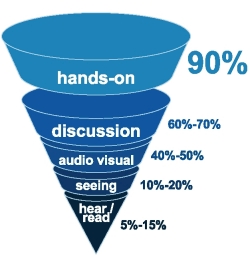
(taken from here)
Essentially, the 'cone of learning' myth runs as follows:
"We remember…
10% of what we read
20% of what we hear
30% of what we see
50% of what we see and hear
70% of what we say
90% of what we say and do"
I've seen this break-down trotted out a number of times by 'consultants' and e-learning salesmen. Thing is, it appears to be complete bunkum. A fascinating whitepaper by Cisco entitled 'Multimodal Learning Through Media: What the Research Says' pans this 'cone of learning' theory as pseudo-scientific nonsense. I heartily recommend the white paper for an entertaining and educational read; but on a more serious note, it also draws our attention to how certain myths take hold in our trade and then get repeated over and over, without any academic research or data to back it up.
So, can anyone else think of any other examples of 'truths' about learning which get trotted out again and again?
Monday, 2 June 2008
Citylapse: 'Just Breathe'
Found at Digital Urban (one of the best digital cartography blogs going):
In case you're curious, the music is Telepopmusik, 'Just Breathe'.
In case you're curious, the music is Telepopmusik, 'Just Breathe'.
[Virtual Worlds] IBM, Virtual Battles and Roy Keane's Mountain Bike Madness

Note: This a blog entry from my MsC in e-learning 'Introduction to Game Design' module.
Reading over the IBM Global Innovation Outlook 2.0 Report, 'Virtual World, Virtual Leaders' I was struck - not by the gee-whizz factoids and structural study of what good leadership entails (the Sloan model of Leadership, apparently) but rather how virtual worlds (and their games) provide opportunities for gamers not normally associated with roles of leadership to have a crack at leading in a safe guided environment:
'Using massively multiplayer online games as a template, it can be argued that leadership is as much a by-product of environment as it is intrinsic. Leadership happens quickly and easily in online games, often undertaken by otherwise reserved players, who surprise even themselves with their capabilities'.
Now, normally speaking, I would launch into my usual banter about obvious applications in the world of Policing and enabling officers to make critical command decisions in a safe, guided environment, but instead I instantly found myself thinking about one Roy Maurice Keane.
Keane's meteoric rise as a football manager (taking Sunderland from the bottom of the Championship to the Premiership in just 8 months) has seen him become the darling of the British red-tops. With Jose Mourinho now off pouting on a beach somewhere, the press have turned to Keane as their rent-a-quote supplier. His down-to-earth manner, self-deprecating wit and willingness to fashion an articulate statement when all around him are awash in a sea of egomania and mobile phone advert contracts, ensures that Keane's every word gets parroted by the media. He has, as one friend of mine observed, a certain undeniable mystique.
But what has all this got to do with virtual worlds? Well, without knowing it, Roy Keane has become an unwitting spokesman for the efficacy of 'Virtual Worlds' and their opportunities for providing just the kind of leadership opportunities which the IBM report cited above describes.
Last season, several newspapers ran the story that Keane had taken to sending his players up the side of mountains, white-water rafting and cross-country biking in what most reported as a simple example of Roy the 'hard man' sorting the men from the boys in increasingly macho team events. What most journos failed to notice was that Keane, through the creation of 'games' ("split into four groups of ten and race up the top of that mountain and back down again") was providing the circumstances for otherwise quiet players to exercise their nascent leadership skills in a (relatively) safe, guided environment.
From a Guardian article of April 19th 2007:
'I gave the lads a challenge yesterday and it was a very difficult challenge - four hours on a mountain bike is not easy," the Irishman said. "We were in four teams of 10 and every team wanted to win."
Rather more importantly, Keane was able to assess how individuals adjusted to being removed from cosily familiar habitats. "I find out who the leaders are, who likes to be in control, who the real winners are," he said. "We've done a lot of this stuff over the last seven months and you find out a lot about your players through different challenges. The lads are comfortable with a football at their feet but throw them on a mountain bike or into a white-water raft and you see another side of them, some good, some maybe not so good. We like to keep them guessing and give them surprises. Yesterday, for instance, they only knew we were going to Swaledale two minutes before we left.
"You'd be surprised who comes to the fore, there were one or two I thought wouldn't enjoy it but did. And it means they look forward to getting
back training here and getting a feel for the ball again."'
So, if a Premiership manager can do it...
Subscribe to:
Posts (Atom)